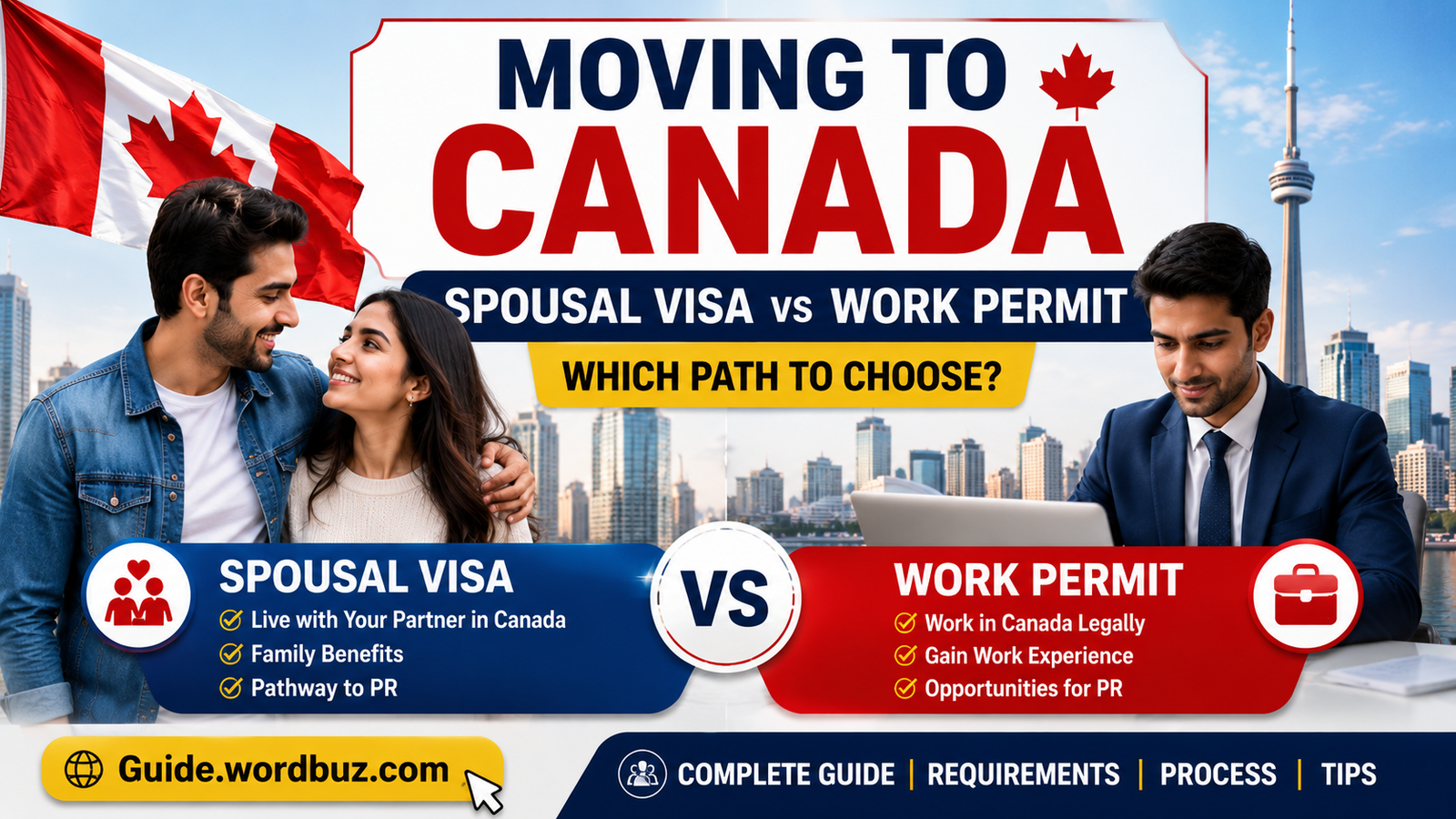
Canada is one of the world’s top destinations for people who want a fresh start. Many choose it because of its strong job market, high quality of life, excellent healthcare, and welcoming communities.
If you’re thinking about moving to Canada, you’ll probably come across two popular immigration options. You can apply through a spouse or partner if you’re in a genuine relationship with a Canadian citizen or permanent resident. Or you can move on a work permit, which may eventually lead to permanent residency.
You may interested In:

👉 USA marriage Visa | Apply Now

👉 Dubai Marriage Visa | Complete Process
This guide explains how both pathways work, who can apply, and what to consider before deciding which option is right for you.
Can You Immigrate to Canada Through Your Spouse or Partner?
Yes. If you are in a genuine relationship with a Canadian citizen or permanent resident, you may qualify for Canada’s family sponsorship program. This pathway allows eligible Canadians to sponsor their spouse or partner for permanent residence, enabling couples to live together permanently in Canada.
Once the application is approved, the sponsored person becomes a permanent resident with the right to live, work, and study anywhere in Canada.
Related Topic:

Understanding Canada’s Spousal Sponsorship Program
Canada recognizes different types of committed relationships under its family sponsorship program.
Married Couples
Legally married spouses can apply for sponsorship if their marriage is valid under Canadian immigration rules.
Common-Law Partners
Couples who have lived together continuously for at least 12 months in a marriage-like relationship may qualify as common-law partners.
Conjugal Partners
This category is intended for couples who have maintained a long-term committed relationship but have been unable to marry or live together because of exceptional circumstances, such as immigration restrictions or legal barriers.
Who Can Sponsor Someone?
Not everyone is eligible to sponsor a spouse or partner. To qualify, the sponsor must:
- Be at least 18 years old.
- Be a Canadian citizen, a permanent resident living in Canada, or a person registered under the Canadian Indian Act.
- Prove that the relationship is genuine and was not entered into mainly for immigration purposes.
The sponsor must also agree to support the applicant financially for a specified period after permanent residence is granted.
Responsibilities of the Sponsor
Sponsorship involves legal and financial obligations. Sponsors are expected to provide for the sponsored person’s basic needs, including housing, food, and clothing if necessary.
A sponsor may not qualify if they
- Are serving a prison sentence.
- Are subject to a removal order.
- Are bankrupt and have not been discharged.
- Have serious criminal convictions affecting eligibility.
- Failed to meet previous sponsorship obligations.
- Receive social assistance for reasons other than a disability.
Who Can Be Sponsored?
The applicant must also satisfy Canada’s immigration requirements.
Generally, they must:
- Be at least 18 years old.
- Be legally married, in a qualifying common-law relationship, or meet the requirements for a conjugal partnership.
- Successfully complete medical, criminal, and security screening.
- Be admissible under Canadian immigration law.
Documents Commonly Required
A successful sponsorship application depends on providing complete and accurate documentation. Typical requirements include the following:
- Marriage certificate or proof of common-law relationship.
- Evidence showing the relationship is genuine, such as photographs, travel records, messages, phone logs, and letters from family or friends.
- Valid passports and national identity documents.
- Police clearance certificates from countries where the applicant has lived for six months or longer since turning 18.
- Immigration medical examination completed by an approved panel physician.
- Financial documents where required.
Common Reasons Applications Are Refused
Many sponsorship applications are approved each year, but avoidable mistakes can result in delays or refusals.
Weak Proof of Relationship
Immigration officers carefully examine whether a relationship is genuine. Applications supported by limited evidence often face additional scrutiny. Providing a variety of documents that demonstrate your life together can significantly strengthen your case.
Missing or Incorrect Documents
Incomplete forms, missing signatures, or outdated documents can delay processing or result in refusal. Always review the official document checklist before submitting your application.
Misrepresentation
Providing false information or fraudulent documents is one of the most serious immigration violations. Misrepresentation can lead to refusal and may result in a ban from applying for Canadian immigration for several years.
Medical or Criminal Inadmissibility
Applicants must satisfy Canada’s admissibility requirements. Certain criminal convictions or medical conditions may affect eligibility, depending on individual circumstances and current immigration laws.
Can You Move to Canada With a Work Visa?
Yes. Many people begin their Canadian immigration journey through employment. A work permit allows eligible foreign nationals to work legally in Canada for a specific period and, in many cases, can become the first step toward permanent residence.
Some work permits require a Canadian employer to obtain government approval before hiring a foreign worker, while others are exempt from that requirement.
Types of Canadian Work Permit
Canada mainly offers work permits through two programs.
International Mobility Program (IMP)
The International Mobility Program allows certain foreign workers to obtain work permits without requiring a Labour Market Impact Assessment (LMIA). These permits are issued when hiring a foreign worker provides broader economic, cultural, or social benefits to Canada or fulfills international agreements.
Temporary Foreign Worker Program (TFWP)
The Temporary Foreign Worker Program generally requires employers to obtain a positive labor market impact assessment before hiring foreign workers. The LMIA confirms that hiring an international worker will not negatively affect the Canadian labor market.
Basic Requirements for a Canadian Work Permit
Although requirements vary depending on the type of permit, applicants generally must demonstrate that they:
- Will leave Canada when their authorization expires unless they qualify to remain.
- Have enough financial resources to support themselves and accompanying family members.
- Do not present a health or security risk.
- Will work only for eligible employers and in authorized occupations.
- Meet all immigration requirements established by Canadian authorities.
Can a Work Permit Lead to Permanent Residence?
Yes. Many temporary foreign workers later become permanent residents.
Canada recognizes the concept of dual intent, meaning a person may legally come to Canada temporarily while also planning to apply for permanent residence in the future.
Several immigration programs allow workers to transition to permanent resident status after meeting specific requirements. Canadian work experience often strengthens an applicant’s profile for permanent residence.
Common requirements may include:
- One to three years of qualifying skilled work experience.
- Meeting English or French language requirements through approved language tests.
- Maintaining valid work authorization.
- Receiving a qualifying job offer or employer support where applicable.
Programs such as Express Entry and various Provincial Nominee Programs frequently serve as pathways from temporary employment to permanent residence.
Marriage Sponsorship or a Work Visa: Which Path Should You Choose?
There isn’t a single answer because the right option depends on your personal situation.
If you are in a genuine relationship with a Canadian citizen or permanent resident, family sponsorship is often the most direct route to permanent residence.
If your goal is to build a career in Canada and you have secured employment, a work permit may be the more appropriate choice. Although temporary at first, it can create opportunities to qualify for permanent residence later.
| Marriage Sponsorship | Work Permit |
|---|---|
| Based on a genuine relationship | Usually requires a Canadian job offer |
| Direct pathway to permanent residence | Starts as temporary status |
| Employment history generally not required | Canadian work experience is valuable |
| Focuses on relationship eligibility | Depends on employer and work permit requirements |
| Permanent residence is the primary goal | May later lead to permanent residence |
Final Thoughts
Canada offers several legitimate immigration pathways, but two of the most widely used are family sponsorship and employment-based immigration. Each option serves a different purpose, and neither is automatically better than the other.
Spousal sponsorship is ideal for individuals in genuine relationships with Canadian citizens or permanent residents, while work permits are designed for people seeking employment opportunities that may eventually lead to permanent residence.
Whichever route you choose, careful preparation is essential. Providing accurate information, submitting complete documentation, and meeting all eligibility requirements can significantly improve your chances of a successful application. By understanding how each pathway works, you can make informed decisions and take the next step toward building a future in Canada.
You Can Check Jobs In Canada: